Short-dated options attract two kinds of trader: the ones who think they can predict the next two hours, and the ones who think they can sell insurance without ever paying a claim. Both are wrong in the same way — they are taking a large, undiversified risk in exchange for a small, frequent reward, and calling the resulting P&L skill.
What follows is the version I actually trade: small, defined-risk structures, selected only when the price of volatility is rich relative to what the market has been realizing, sized so that the worst case is boring, and closed on rules rather than on hope.
01The only edge I trust
Implied volatility is a forecast that is usually a little too high. That premium is compensation for bearing risk, and it exists because the seller of options is providing insurance against a jump. Collecting it works on average and fails violently in the tail, which is why the structure matters more than the forecast.
I do not claim to predict direction on a 0–5 day horizon. I claim two narrower things: that when implied volatility is elevated relative to recent realized volatility, the expected value of selling defined-risk premium is positive; and that a mechanical exit removes the behavioral errors that turn a positive-expectancy process into a negative one.
If the worst case of an expiry is not boring, the position is too large — regardless of how good the setup looks.
02Structure selection
Every position is an iron condor or a vertical credit spread: defined risk on both sides, no naked exposure, no margin call that can arrive before the thesis gets a chance to be right. The short strikes sit outside the expected move; the long strikes define the maximum loss.
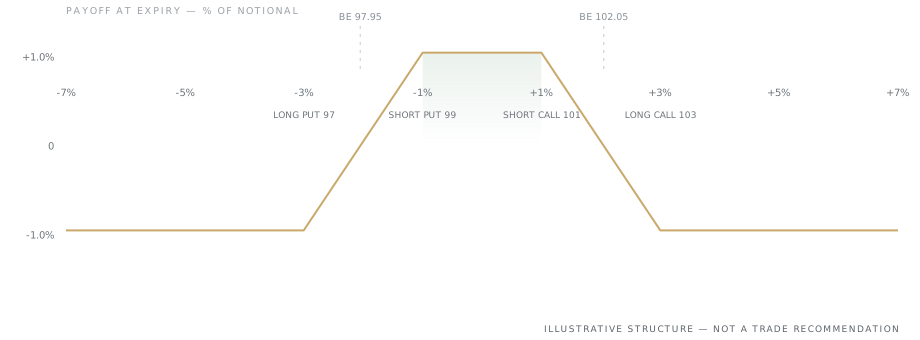
The choice between a condor and a single vertical is a statement about which side of the distribution is more expensive. When skew is steep, the put side pays more for the same distance; when the market has rallied hard into a event, the call side can be the richer sale. The structure follows the pricing, not a directional guess.
03Entry filters
No trade is taken unless all four conditions hold. The filters exist to keep the process out of the setups where the historical edge is weakest.
| Filter | Condition | Why it exists |
|---|---|---|
| Volatility richness | Implied > 1.15× 10-day realized | Without a premium, the trade is a coin flip with costs |
| Event calendar | No CPI, FOMC, payrolls or earnings inside the expiry | A binary event is not a variance trade |
| Trend filter | No entry against a strong multi-day trend | Short premium into a trend is how accounts die |
| Liquidity | Spread < 8% of credit; open interest at both strikes | You cannot manage what you cannot exit |
The event filter costs a meaningful number of opportunities. It also removes the trades whose loss distribution has a fat tail that no amount of historical backtesting captures well.
04Sizing by maximum loss
Position size is set by the maximum loss of the structure, not by the credit received and not by the notional. A single position may risk at most 1% of the account; total open risk across all expiries is capped at 4%. When the cap binds, the next setup is skipped — not resized.
This is the rule that makes the strategy survivable. A 90% win rate with 1% risk per trade is a business. The same win rate with 10% risk is a countdown.
05Management rules
- 01Take profit at 50% of credit.Closing early gives up some premium and removes the gamma risk that arrives in the final day. The trade-off is deliberate.
- 02Close at 21 DTE or one day before expiry, whichever is first.Short-dated structures are held for days, not weeks. Time stops prevent a small winner from becoming a large loser.
- 03Exit on a short-strike breach.If the underlying closes beyond a short strike, the position is closed at the next opportunity. No rolling, no averaging down, no widening.
- 04Stop for the day after two losses.Two losses in a session usually means the regime has changed. The correct response is to stop trading, not to size up.
Every rule is written down before the trade and recorded after it. The point is not to be right about the market; it is to make the same decision twice.
06Execution realities
Backtests of option strategies are usually optimistic in three specific ways, and each one is worth modeling explicitly.
- Fills at mid. Short-dated spreads are wide. A backtest that assumes mid fills is measuring the spread, not the strategy. My records use the actual fill, and the difference is material.
- Assignment and pin risk. A short strike finishing at the money can produce an assignment that changes the risk profile after the fact. Closing before expiry is the practical defense.
- Gap risk. A defined-risk structure limits loss at expiry, but the mark-to-market loss before expiry can be larger than the modeled maximum if the position is held into a gap. The loss budget is enforced on marks, not only on settlement.
07The journal is the strategy
Every trade is logged with entry credit, implied versus realized volatility at entry, the structure, the exit reason and the P&L. The log is reviewed monthly with one question: did the rules produce the result, or did I deviate and get lucky?
That review is the actual edge. The structures are standard, the filters are simple, and none of it is proprietary. What is proprietary is the record of following the process when it was uncomfortable — and the willingness to change the process when the record says it is wrong.
For discussion only. Not investment advice, not a trade recommendation, and not a representation of actual or expected performance. Options involve risk and are not suitable for all investors.
Back to work